|
| Half Dome Trail |
Today we hike Half Dome. This is it. This is the day I have been planning for, preparing for, and, yes, waiting for, for three long years. Only God knew how long it would take me to summit, and that I would persevere until today. (I suspect Duane knew this too. Being my husband he knows full well how stubborn I am!)
We woke up at 5:00 am, and took an hour to dress, wash, eat and get ready. We were boots on trail by 6:00 am. It's not that we're insane. We are, by nature cautious and careful. Thunder and lightning storms often show up in the summer, particularly in late July and August, sometime around 2-3:00 pm.
 |
Permit Reminder Sign and No Camping above
7600 ft. sign at the beginning of the Half Dome Trail |
This means you need to summit Half Dome with enough time to get yourself down before any possibility of storms. Since the approach to Half Dome is from the East, and the storms move in from the West, hikers often have little idea that a storm is approaching, at least until they get to the ridgeline and sometimes longer. Once a hiker is on subdome, the hiker is fully exposed to the weather and there is no shelter from lightning strikes. So getting to the top of Half Dome early in the day is the rule, not the exception.
 |
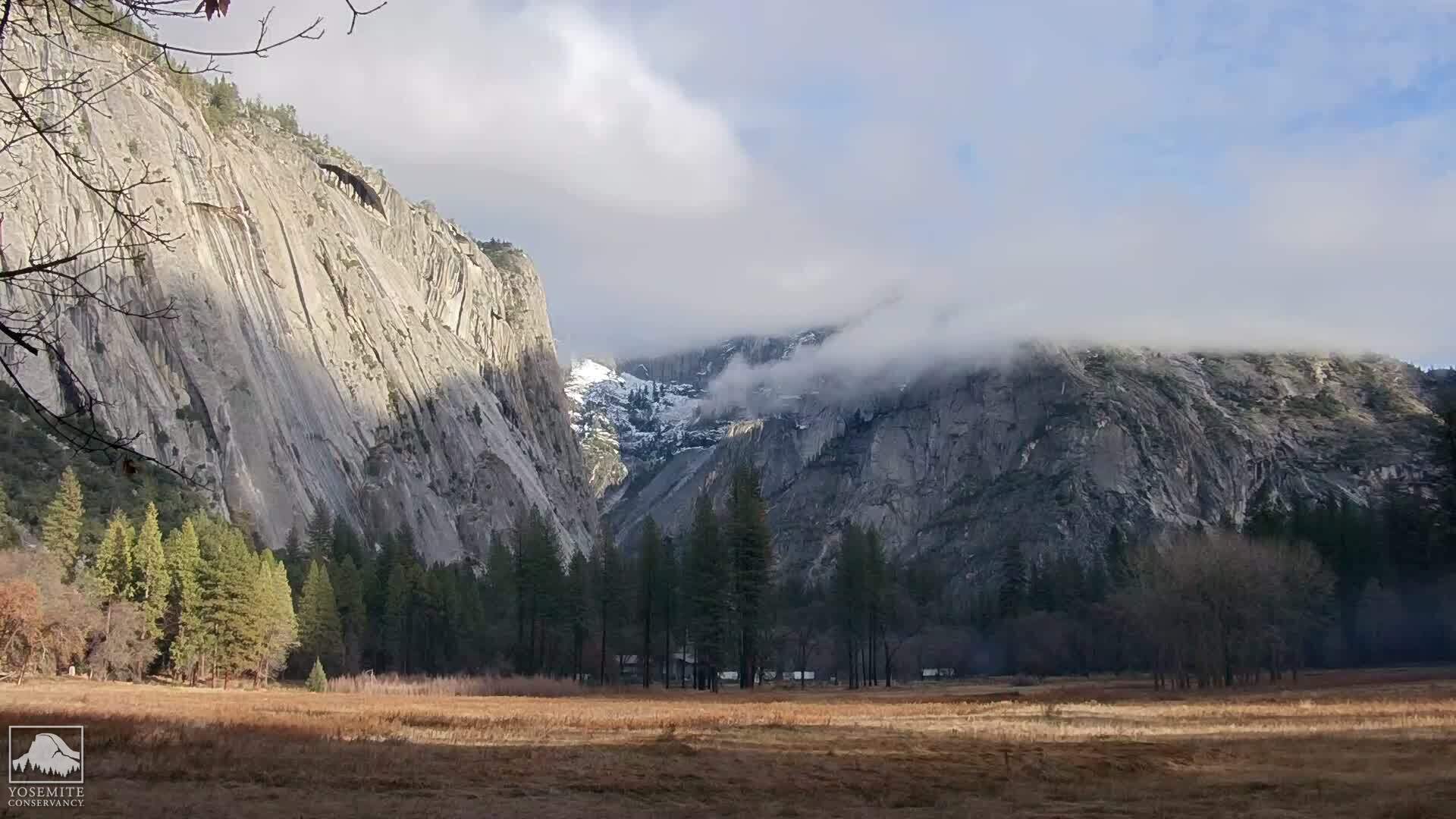
| The view of Half Dome is obliterated by clouds. |
The weather today is overcast, almost like a foggy San Francisco morning. Would it clear up? Would Half Dome's granite be dry enough to allow an ascent by the cables? The only way to find out would be to hike there.
The contents of today's day pack are a little different than an ordinary hike. I have with me full water (three liters) and one liter of electrolyte today, lunch, trail mix, electrolyte gels, as well as rubber gloves and a climbing harness, with two runners and weight-bearing carabiners. (Not the kind of cute, decorative little carabiners that are served attached to an "El Capitini" at the Ahwahnee, but I digress.) There is a spring where we can pump water a few switchbacks past the junction to Clouds Rest. There are also some other ephemeral rivulets, but this is July so they can't be counted on. Alan was carrying our water pump.
We passed the warning signs at the beginning of the Half Dome trail, and started the series of interminable switchbacks that rise all the way up to the ridgeline. A few switchbacks into the hike, Tirina decided to return to camp. She wasn't feeling well, so Alan returned with her, after giving us the water pump. Today's attempt at Half Dome would belong to Chris and I.
 |
| Half Dome - Clouds Rest Junction |
We reached the Cloud's Rest junction withe no further event. Such a different experience than when I hiked this trail in 2009. I am now more physically fit, and because of the permit system, there aren't hundreds of people passing us up. In fact, we are so early, that there are very few people on the trail.
When we get a few switchbacks past the spring, I am now in uncharted territory. The switchbacks begin to level off as we reach the ridgeline, and the hiking becomes much easier. I was amazed at how close we had come the first time. Another difference: there isn't a meat bee in sight! Yeah! I am unlikely to be attacked every time I try to take a bite of my sandwich.
 |
| Warning Sign at the foot of Subdome |
A short while later, we reached the base of Subdome and its hundred - perhaps thousands - of granite steps, blasted with dynamite by federal workers in the 1930s. The weather is still foggy, but it's not ominous or looking like it will rain. No thunderheads that we can see or dark bottomed clouds.
Subdome is legendary for being the most physically demanding part of the Half Dome hike. Most hikers are doing it in full sun, with no cover, and after having already hiked 7 miles with an elevation gain of nearly 4000 feet. By contrast, we had hiked only 3 miles with an elevation gain of about 1000 feet. We still had plenty of energy and, benefited by the cloud cover, reached the top of Subdome very quickly.
 |
| Half Dome Cables, July 15, 2011 |
At the very top of Subdome, the granite steps have worn out and disappeared. Making your way up the very steep granite, with nothing to hold onto, is very disconcerting. Chris kept telling me to trust my boots, and as is my usual way, I just carried on. When we reached the top of Subdome and started down the saddle that separates Subdome from Half Dome, we couldn't even see the cables or the top of Half Dome. They disappeared into the clouds. The big question of the day was whether the granite was dry enough to ascend the cables. It turned out that it was, so Chris and I decided to make a go of it.
I stopped to rest and eat a little trail mix at the base of the cables. Then I packed my hiking poles, and donned my climbing harness. Everything on the outside of my pack was attached by carabiners. I had heard too many stories and seen too many videos of people losing their hats, poles, water bottles and other paraphernalia while ascending the cables. I not only didn't want to lose any equipment, I didn't want to be the cause of misfortune to anyone coming up behind and below me. This is a great video from
Mr. Half Dome (aka Rick Deutsch) of what it is like to go up the cables:
Rick literally wrote
the book on the Half Dome hike and, although I wouldn't ever advise someone to hike outside of the cables, Rick has done this hike over 30 times and he knows both what he is doing and the risks he is taking. I made my way up the cables carefully, slower than some and faster than others. I had one carabiner clipped on to the cable, and as I reached a pole, I would clip the other carabiner to the cable above the pole, and then unclip the bottom carabiner. It was slower to do it this way, but I was not going to take any unnecessary risks with a seven year old son at home. Several of my fellow Half Dome hikers saw what I was doing and commented what a good idea it was and how they wished they had thought of that. Even so, I met only one other person with a climbing harness that day.
 |
| Half Dome Summit |
I found the cable section of the hike more physically demanding than Subdome, perhaps because I don't have as much upper body strength as younger or male hikers. By the time I got 2/3rds of the way up the cables my arms were shaking, but except for that I didn't find it particularly difficult. As I went up the cables, I saw water bottles slide down the face and a hat that had blown about 30 feet away from the cables and would have blown off the Dome had it not caught on something. It might as well have blown Outer Mongolia, because it was nevertheless beyond anyone's reach.
 |
| Half Dome Summit, Above the Clouds |
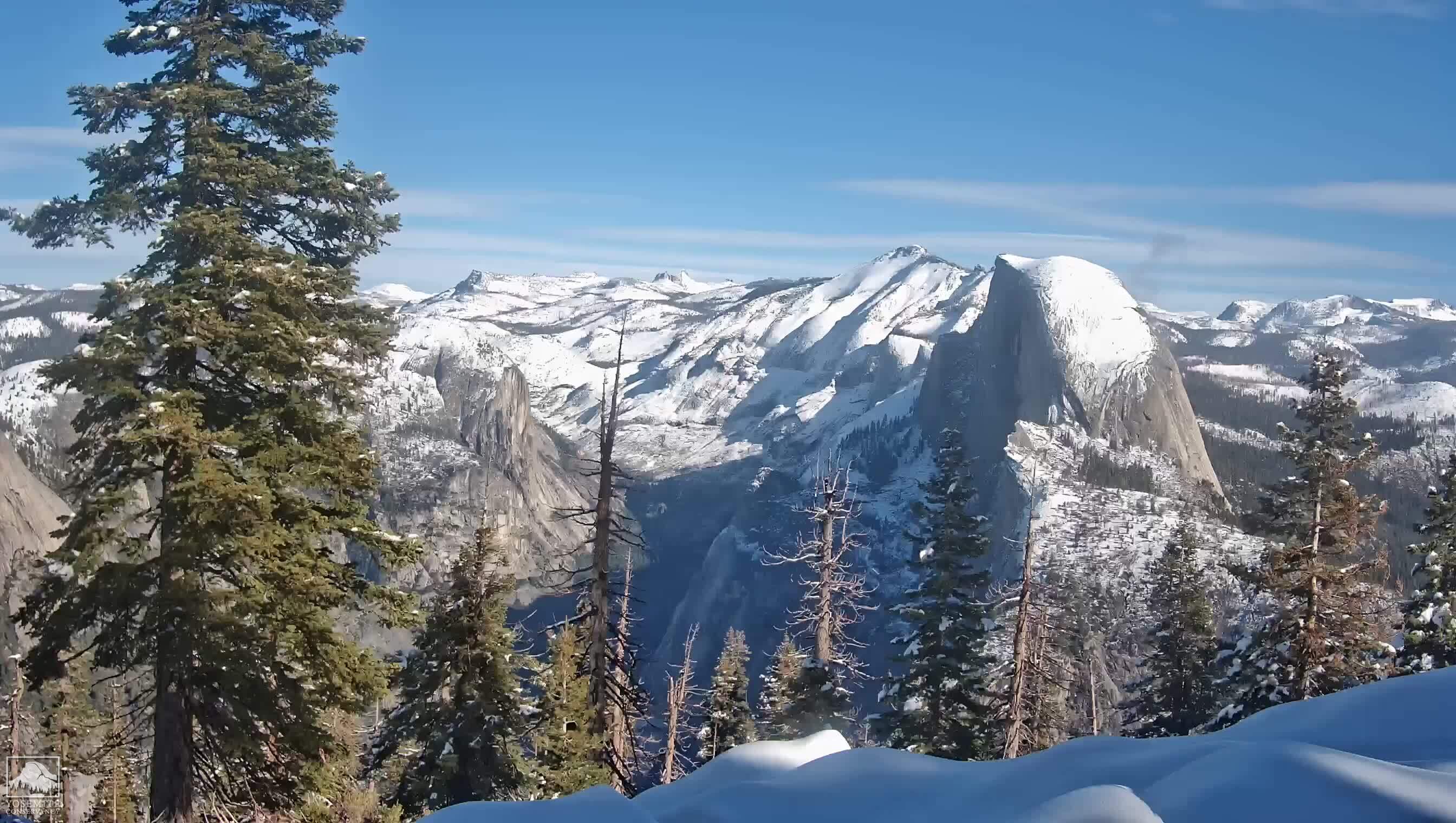
Just as we got to the top of the cables, the clouds began to clear, revealing a glorious day with 360 degree panoramic views of Yosemite. It was lovely! But was I really here? I felt I need to pinch myself to make sure. I borrowed Chris' cell phone and called Duane from the top of Half Dome. He was surprised to hear from me and so early. I had no idea what time it was. It turned out to be about 10:45 am. We had made very good time, giving us plenty of opportunity to explore!
 |
| Marmot atop Half Dome |
We sat down to rest and eat our lunch before exploring the top, and encountered marmots who, if given the chance, would happily steal your lunch! We ate ours before they had a chance.
After lunch, we walked around the top of Half Dome for a while. There is a dip in the middle, and this is where you want to go should you ever get caught in a lightning storm. In 1985, 5 hikers foolishly hiked to the top of Half Dome in a lightning storm and were hit by lightning while they were hiding in the cave at Eagle's Beak. Two of them died. This incident was the subject of the book,
Shattered Air by Bob Madgic. It's well worth reading, not only for an understanding of what can go wrong, but as a chronicle of hubris.
 |
Eagle's Beak,
4800 feet down to the Yosemite Valley |
We gave our cameras to a fellow hiker, asking him to take a photo of us, and then walked out to Eagle's Beak for an iconic victory photo! (You can see the cave in between us.) Still, I could hardly believe I'd made it to the top!
 |
| Christina Sand & Chris Swartout, on Eagle's Beak |
 |
| Hiking to the Northwest side of Half Dome Summit |
I needed to walk around a bit more to convince myself that I was really, truly here! So we walked over to the Northwest side for a gorgeous view of Yosemite Valley. It's amazing how small Yosemite Falls looks from Half Dome. The Ahwhahnee on the valley floor looks about the size of an ant. In all, we spent about a half an hour at the top, enjoying the tremendous views and panoramic vistas. It was truly wonderful!
 |
Christina Sand & Chris Swartout,
Base of the Half Dome Cables |
We started down the cables again, this time in full sun. Still it wasn't hot, only warm, and that was fine with us. The question was whether to go down face first or butt first, i.e., backwards. I chose to go down backwards for a couple of reasons. I didn't want to see the drop, and I also wanted the most control possible as I descended. I wanted to be able to focus on what I was doing without the distraction of looking down and worrying. I descended very quickly, so quickly I got to the bottom almost without realizing it.
 |
| Half Dome Cables |
Finally, we could see what we had just climbed, and the view was yet another different slice of Half Dome. Since it was still early in the day, there were very few people at the cables, even less so now with the permit system in place. We took one long, last look before continuing on down Subdome.
 |
| Top of Subdome, looking at Tenaya Canyon |
Subdome proved to be harder on the knees on the way down, as I knew it would. The most disconcerting part was descending at the very top of Subdome, where the granite is nearly as steep as the cable section of Half Dome, but there are no cables or steps. I walked down very carefully, making sure not to put my foot on sand over granite, following Chris and remembering to "trust my boots"!
 |
| The Base of Subdome |
It was hotter than when we had come up and there was less cloud cover, but we still had plenty of water, electrolyte and trail mix, and our daypacks were now lighter for having consumed some of our supplies. As we neared the base of Subdome, we began to see more and more trees. We met park rangers on the way down who asked for our permits. We hadn't seen them this morning because we got to Subdome ahead of them.
 |
Edge on view of Subdome,
in front of Half Dome |
We continued down the ridgeline, stopping to take one last spectacular photo of both Subdome and Half Dome. We met hikers on their way up and gave them encouragement. Amazingly, we found a rivulet that was still running, undoubtedly due to the heavy and late rainfall, and stopped to pump some water, rest and readjust our boots and socks. This portion of the trail is lush and verdant and is probably my favorite portion of the Half Dome trail.
 |
| Chris Swartout pumping water at the rivulet |
The weather continued to be in our favor. The cloud cover had provided a respite from the sun for long enough that it never really got very hot. It turned out to be perfect hiking weather Half Dome! We were very blessed. This time lapse video of July 15, 2011 shows the cloud cover. When you see it break, that's the time that we had made it to the top.
When we got back to camp it was about 2:00 pm. The day was barely half over! Tirina was feeling better. I took off my boots, slipped on my camp sandals, crawled into my sleeping bag and took a nap, with a smile on my face.

 Half Dome Challenge has been a chronicle of my journey up a mountain and into better health, and of the many interesting things that happened along the way. As with all journeys, there have been many people and organizations along the way who encouraged and supported me in this endeavor. I would like to thank the following people and organizations: